 Esperanto
 Shqiptare
 Euskara
 Zulu
 Latinus
 Cymraeg
 தமிழ்
 Slovak
 Slovak
 Afrikaans

News Center
The difference between CCD and CMOS industrial cameras
Publish:
2022-08-21 11:01
Source:
www.premier-cable.net
The difference between CCD and CMOS industrial cameras
1. Imaging process
The principle of photoelectric conversion of CCD and CMOS image sensor is the same, and the main difference between them is that the signal readout process is different. Since the CCD has only one (or a few) output nodes to read out uniformly, the consistency of its signal output is very good.
In a CMOS chip, each pixel has its own signal amplifier, which performs charge-voltage conversion, and the consistency of its signal output is poor. However, in order to read out the entire image signal, the CCD requires a wide signal bandwidth of the output amplifier. In a CMOS chip, the bandwidth requirement of the amplifier in each pixel is low, which greatly reduces the power consumption of the chip. This is the CMOS chip. The main reason for lower power consumption than CCD.
Despite the reduced power consumption, the inconsistency of the multi-million amplifiers results in higher stationary noise, again an inherent disadvantage of CMOS over CCD.
2. Integration
From the point of view of the manufacturing process, the circuits and devices in CCD are integrated on the semiconductor single crystal material, and the process is relatively complicated. Only a few manufacturers in the world can produce CCD wafers. The CCD can only output analog electrical signals, which requires subsequent processing by an address decoder, an analog converter, and an image signal processor. It also needs to provide three sets of power synchronous clock control circuits with different voltages, so the integration is very low.
CMOS is integrated on a single material called metal oxide. This process is the same as that used to produce tens of thousands of semiconductor integrated circuits such as computer chips and storage devices. Therefore, the cost of producing CMOS is much lower than that of CCD. . At the same time, the CMOS chip can integrate the image signal amplifier, signal reading circuit, A/D conversion circuit, image signal processor and controller into one chip. Only one chip can realize all the basic functions of the camera. Very high, the chip-scale camera concept was born from this. With the continuous development of CMOS imaging technology, more and more companies can provide high-quality CMOS imaging chips.
3. Speed
CCD adopts photosensitive output one by one, and can only output according to the specified program, and the speed is relatively slow. CMOS has multiple charge-voltage converters and row-column switch control, and the readout speed is much faster. Most of the high-speed cameras above 500fps are CMOS cameras. In addition, the address strobe switch of CMOS can be randomly sampled to realize sub-window output, and a higher speed can be obtained when only the sub-window image is output.
4. Noise
CCD technology has developed earlier and is relatively mature. It uses PN junction or silicon dioxide (SiO2) isolation layer to isolate noise, and the imaging quality has certain advantages over CMOS photoelectric sensors.
Source: Premier Cable Co., Ltd. specializes in providing industrial camera related cables, website address: https://www.premier-cable.net/product/Camera-Link-Cables-10
Keywords : Industrial CCD camera, Industrial CMOS camera
Industrial CCD camera cable
Industrial CMOS camera cable
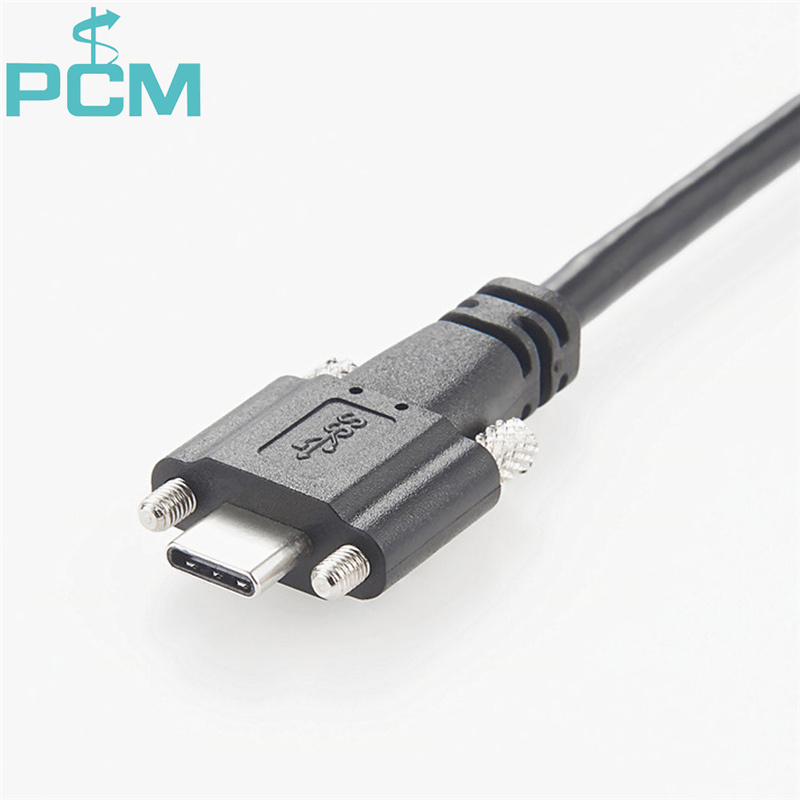
USB 3.1 C with Dual Screw Locking
Machine Vision USB 3.0 Cable Micro-B Plug
GigE patch cable Cat6 dragchain screwable
Screw Lock USB 3.0 Type A Male to Type A Male 24/28AWG Cable


Related News
10M Quad MATE-AX & HFM Mini FAKRA 4-in-1 Cable Assemblies Now Available – Stock Ready, No MOQ
The 10M Quad MATE-AX & HFM Mini FAKRA 4-in-1 Cable Assemblies is ideal for connecting cameras, sensors, radar modules, area controllers, and domain control units in modern vehicles, buses, coaches, passenger buses, trucks, and commercial transportation systems.
7/8" Power Cable Solution for AGV and AMR Robotics Applications
Premier Cable’s DeviceNet 7/8" power cables for AGV and AMR robots, deliver the stability, durability, and flexibility required for next-generation robotic systems. Start Your Custom Cable Project Today! Get reliable power solutions for your AGV or AMR system!
GMSL Camera Cables Solution for Automotive In-Vehicle Developer System and Robotic
Looking for reliable and customizable GMSL camera cables? Premier Cable provide GMSL, GMSL2, and GMSL3 camera cable with Fakra and Quad Fakra, customizable for NVIDIA DRIVE AGX Thor Developer Kit, automotive, unmanned vehicles, robotics, AMR, and smart cities.
Premier Cable MATE-AX & H-MTD GMSL Ethernet Cable for NVIDIA DRIVE AGX Thor Developer Kit
Premier Cable provide custom MATE-AX & H-MTD breakout cables for NVIDIA DRIVE AGX Thor, supporting humanoid robots, machine vision, Industrial Vehicles, Robotics, and Autonomous Machines.
How H-MTD Cable Empower Robotaxi and Autonomous Driving Systems
H-MTD cable assemblies enable high-speed automotive Ethernet for Robotaxi, supporting cameras, LiDAR, and ADAS with customizable solutions.
Premier Cable Launches TE 282762-1 2 Way Automotive Cable Assembly
Premier Cable introduces the TE 282762-1 AMP Junior Power Timer automotive wiring harness, customizable, and widely used in sensors, fuel injection, ignition systems, and turn signals.