 Esperanto
 Shqiptare
 Euskara
 Zulu
 Latinus
 Cymraeg
 தமிழ்
 Slovak
 Slovak
 Afrikaans

News Center
CAN bus protocol
Publish:
2022-07-24 23:19
Source:
www.premier-cable.net
CAN bus protocol
Controller Area Network (CAN, Controller Area Network) is a serial communication protocol bus for real-time applications. It can use twisted pair to transmit signals and is one of the most widely used field buses in the world.
The CAN protocol is used to communicate between the various components in the car, replacing expensive and bulky power distribution wiring harnesses. The robustness of this protocol extends its use to other automation and industrial applications.
Features of the CAN protocol include complete serial data communication, real-time support, transmission rates up to 1Mb/s, 11-bit addressing and error detection capabilities.
CAN bus development
Controller Area Network CAN (Controller Area Network) belongs to the category of field bus and is a serial communication network that effectively supports distributed control systems.
It is a serial communication bus specially developed for the automotive industry by the German Bosch company in the 1980s. Due to its high performance, high reliability and unique design, it has been paid more and more attention by people and is widely used in many fields.
When the signal transmission distance reaches 10km, CAN can still provide a data transmission rate of up to 50kbit/s. Due to the high real-time performance and application scope of the CAN bus, it can be arbitrarily matched from a high-speed network with a bit rate of up to 1Mbps to a low-cost multi-line 50Kbps network.
Therefore, CAN has been widely used in the automotive industry, aviation industry, industrial control, safety protection and other fields.
With the wide application of CAN bus in various industries and fields, stricter requirements are also put forward for the standardization of its communication format.
In 1991, the CAN bus technical specification (Version2.0) was formulated and released. The technical specification includes two parts, A and B.
Among them, 2.0A gives the standard format of CAN message, and 2.0B gives two formats of standard and extended. The American Society of Automotive Engineers SAE proposed the J1939 protocol in 2000, which has since become a common standard for controller area networks in trucks and passenger cars.
CAN bus technology is also evolving. The traditional CAN is triggered based on events, and the uncertainty of information transmission time and priority inversion are its inherent defects. When the density of messages transmitted on the bus is small, these defects have little effect on the real-time performance of the system; but with the increase of the density of messages transmitted on the bus, the real-time performance of the system will drop sharply.
In order to meet the ever-increasing demands of real-time performance and transmission message density for automotive control, it is necessary to improve the real-time performance of the CAN bus. Therefore, the combination of traditional CAN and time-triggered mechanism produces TTCAN (Time-Triggered CAN), and ISO11898-4 has included TTCAN.
The difference between the TTCAN bus and the traditional CAN bus system is that different messages on the bus define different time slots (Timer Slot).
How the CAN bus works
The CAN bus uses a serial data transmission method, which can run on a twisted pair of 40m at a rate of 1Mb/s, or use an optical cable to connect, and the bus protocol supports multiple master controllers on this bus.
CAN is similar to the I2C bus in many details, but there are some notable differences. When a node (station) on the CAN bus sends data, it is broadcast to all nodes in the network in the form of a message.
For each node, whether the data is sent to itself or not, it is received. The 11-bit characters at the beginning of each group of messages are identifiers, which define the priority of the messages. This message format is called a content-oriented addressing scheme.
Identifiers are unique in the same system, and it is impossible for two stations to send messages with the same identifier. This configuration is important when several stations are competing for bus reads at the same time.
When a station wants to send data to other stations, the CPU of the station transmits the data to be sent and its own identifier to the CAN chip of the station, and is in a ready state; when it receives the bus assignment, it turns to send a message state.
The CAN chip organizes the data into a certain message format according to the protocol and sends it out. At this time, other stations on the Internet are in the receiving state. Each station in the receiving state detects the received messages and judges whether these messages are sent to itself, so as to determine whether to receive it.
Since the CAN bus is a content-oriented addressing scheme, it is easy to build a high-level control system and configure it flexibly. We can easily add some new stations to CAN bus without modification in hardware or software.
When the provided new station is a pure data receiving device, the data transfer protocol does not require a separate part to have a physical destination address. It allows the synchronization of distributed processes, that is, when the controller on the bus needs to measure data, it can be obtained online, without each controller having its own independent sensor.
Scope of use
Applications in automobile manufacturing, applications in large-scale instruments and equipment, applications in industrial control, applications in smart home and living community management, and applications in robot network interconnection.
At the same time, due to the characteristics of the CAN bus itself, its application range is no longer limited to the automotive industry, but also to automatic control, aerospace, navigation, process industry, machinery industry, textile machinery, agricultural machinery, robots, CNC machine tools, medical equipment. and sensor development.
CAN has formed an international standard and has been recognized as one of the most promising fieldbuses.
Premier Cable CO LTD is a cable factory with 400 workers, we also make USB serial cable , USB to RS232 RS485 cable, OEM Cable and Wire Harness
For different application, we also make the DB9 connector and RS232 Cable angled, like right angle RS232 Cable, left angle RS232 Cable, up angle RS232 Cable, down angle RS232 Cable
Welcome to your inquiry or visit our Website : www.premier-cable.net
Our cables can be used for below industry or applications :
OBD CAN Bus analyzer
RS232 to CAN converter
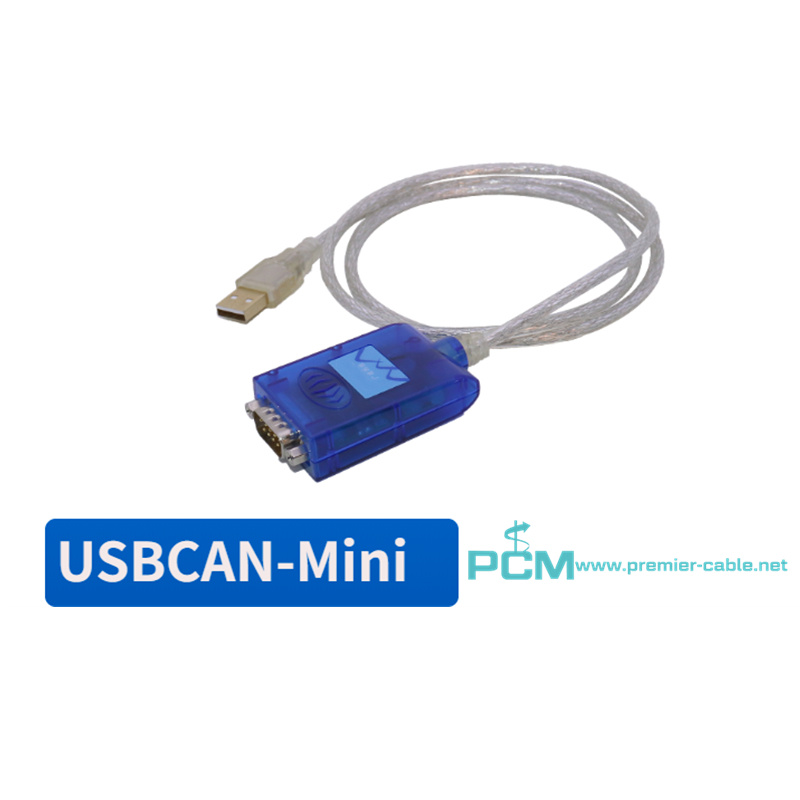
USB to CAN bus analyzer
USB to CAN bus converter
PEAK-System CAN interface
PEAK PCAN-USB IPEH-002022
RS-232/422/485 Data Gateway
USB CAN and CAN FD interface
USB Diagnostic Interface CANBUS
Tel : 0086-0139-2949-7934
Skype : james198585
Email : James@premier-cable.net
Email : sales@premier-cable-mfg.com



Related News
10M Quad MATE-AX & HFM Mini FAKRA 4-in-1 Cable Assemblies Now Available – Stock Ready, No MOQ
The 10M Quad MATE-AX & HFM Mini FAKRA 4-in-1 Cable Assemblies is ideal for connecting cameras, sensors, radar modules, area controllers, and domain control units in modern vehicles, buses, coaches, passenger buses, trucks, and commercial transportation systems.
7/8" Power Cable Solution for AGV and AMR Robotics Applications
Premier Cable’s DeviceNet 7/8" power cables for AGV and AMR robots, deliver the stability, durability, and flexibility required for next-generation robotic systems. Start Your Custom Cable Project Today! Get reliable power solutions for your AGV or AMR system!
GMSL Camera Cables Solution for Automotive In-Vehicle Developer System and Robotic
Looking for reliable and customizable GMSL camera cables? Premier Cable provide GMSL, GMSL2, and GMSL3 camera cable with Fakra and Quad Fakra, customizable for NVIDIA DRIVE AGX Thor Developer Kit, automotive, unmanned vehicles, robotics, AMR, and smart cities.
Premier Cable MATE-AX & H-MTD GMSL Ethernet Cable for NVIDIA DRIVE AGX Thor Developer Kit
Premier Cable provide custom MATE-AX & H-MTD breakout cables for NVIDIA DRIVE AGX Thor, supporting humanoid robots, machine vision, Industrial Vehicles, Robotics, and Autonomous Machines.
How H-MTD Cable Empower Robotaxi and Autonomous Driving Systems
H-MTD cable assemblies enable high-speed automotive Ethernet for Robotaxi, supporting cameras, LiDAR, and ADAS with customizable solutions.
Premier Cable Launches TE 282762-1 2 Way Automotive Cable Assembly
Premier Cable introduces the TE 282762-1 AMP Junior Power Timer automotive wiring harness, customizable, and widely used in sensors, fuel injection, ignition systems, and turn signals.