 Esperanto
 Shqiptare
 Euskara
 Zulu
 Latinus
 Cymraeg
 தமிழ்
 Slovak
 Slovak
 Afrikaans

News Center
Analysis of Serial UART Interface of FT232R
Publish:
2022-07-04 12:26
Source:
www.premier-cable.net
Analysis of Serial UART Interface of FT232R
Use a TTL to RS232 level converter IC on the FT232R's serial UART interface to convert the FT232R's TTL level to RS232 level.
This level shifting can be done using the currently available "213" series TTL to RS232 level shifters. These "213" devices typically have 4 transmitters and 5 receivers, and have built-in voltage translators that convert the +5V (nominal) VCC to the +/- 9V required by RS232. A useful feature of these devices is the SHDN# pin, which can be used to power down the device to a low quiescent current in USB suspend mode.
An example is the Sipex SP213EHCA, which is a very suitable level shifting IC capable of RS232 communication at baud rates up to 500k.
If lower baud rates are acceptable, several pin-to-pin alternatives are available, such as the Sipex SP213ECA, the Maxim MAX213CAI, and the ADI ADM213E, all suitable for communication up to 115.2k baud. If higher baud rates are required, the Maxim MAX3245CAI device supports RS232 communication rates up to 1M baud. Note that the MAX3245 is not pin compatible with 213 series devices, the SHDN pin of MAX devices is active high and should be connected to the PWREN# pin instead of the SLEEP# pin.
In the example above, CBUS0 and CBUS1 have been configured as TXLED# and RXLED# and used to drive two LEDs.
Secondly, we can realize the USB to RS485 interface through the RS485 transceiver.
Analysis of Serial UART Interface of FT232R
In this application, a TTL to RS485 level converter IC (Sipex SP481) is used on the FT232R's serial UART interface to convert the FT232R's TTL level to RS485 level. The SP481 is an RS485 based 8-pin SOP packaged device with separate enable on both transmitter and receiver. When using RS485, the transmitter is only enabled when sending characters from the UART. It is for this purpose that the TXDEN signal CBUS pin option on the FT232R is provided, so the transmitter enable is connected to CBUS2 which is configured as TXDEN. Likewise, CBUS3 has been configured as PWREN#. This signal is used to control the receiver enable of SP481. The receiver enable is active low, so in USB suspend mode, it is connected to the PWREN# pin to disable the receiver. CBUS2 = TXDEN and CBUS3 = PWREN# are the default device configurations for the FT232R pins.
Furthermore, USB to RS422 interface circuit.
Analysis of Serial UART Interface of FT232R
In this application, two TTL to RS422 level converter ICs are used on the FT232R's serial UART interface to convert the FT232R's TTL level to RS422 level. Likewise, there are many suitable level shifters on the market. For example the Sipex SP491 used on the transmitter and receiver in the picture above. Since the SP491 transmitter enable is active high, it is connected to the CBUS pin in the SLEEP# configuration. The SP491 receiver enable is active low and therefore connected to the CBUS pin PWREN# configuration. This ensures that the device is active when both the SP491 transmitter and receiver are enabled; when the device is in USB suspend mode, the SP491 transmitter and receiver are disabled.
If a similar application is used, but the design is powered by the USB BUS, it may be necessary to use a P-channel logic level MOSFET (controlled by PWREN#) in the VCC line of the SP491 device to ensure that the USB standby current is 2.5mA. The SP491 is specified to send and receive data at rates up to 5 Mbaud. In this example, the FT232R limits the maximum data rate to 3 Mbaud. Or there is a serial port application for USB to MCU.
Analysis of Serial UART Interface of FT232R
As the No.1 device in the hot list of bus controllers, FT232R is still remarkable. It can be used in many applications. The application functions in each product can also be flexibly adjusted, but the changes are the same. I I think the most important part is to rely on the huge USB interface, so this kind of USB-to-serial controller, which can be called a circuit miracle, is derived.
Serial UART Cable
USB to RS422 interface Cable
USB to RS485 interface Cable
TTL to RS232 level converter Cable
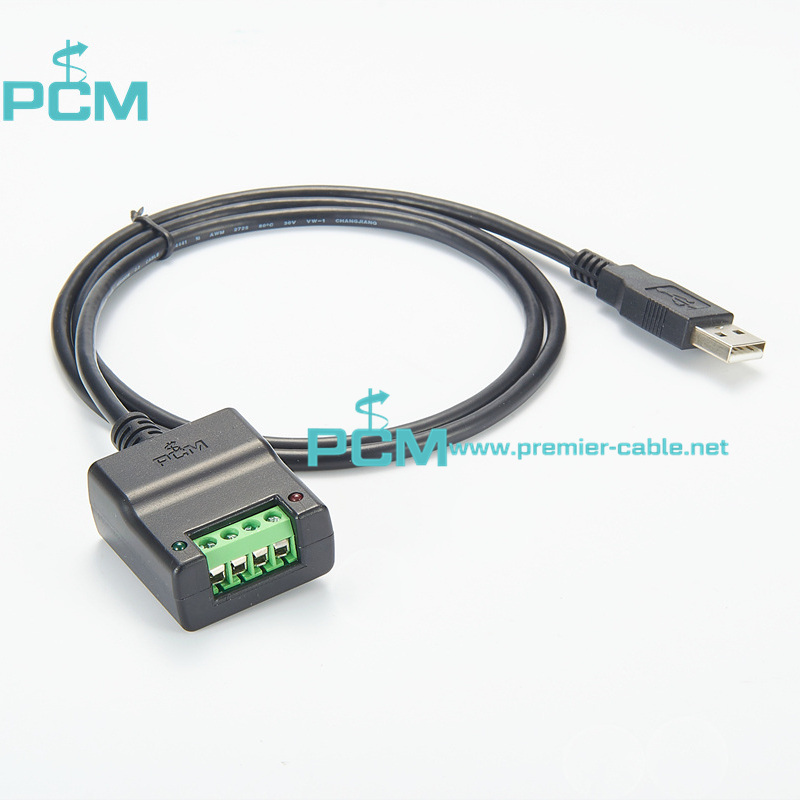
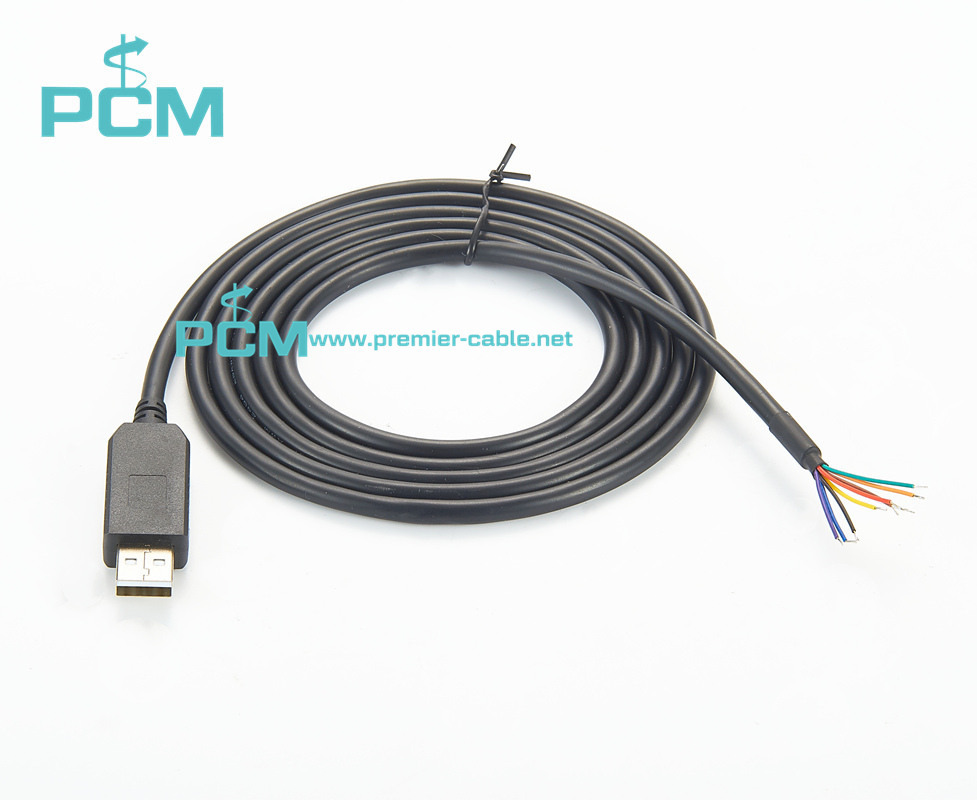
Serial UART Interface FT232R Cable
Tel : 0086-0139-2949-7934
Skype : james198585
Email : James@premier-cable.net
Email : sales@premier-cable-mfg.com



Related News
10M Quad MATE-AX & HFM Mini FAKRA 4-in-1 Cable Assemblies Now Available – Stock Ready, No MOQ
The 10M Quad MATE-AX & HFM Mini FAKRA 4-in-1 Cable Assemblies is ideal for connecting cameras, sensors, radar modules, area controllers, and domain control units in modern vehicles, buses, coaches, passenger buses, trucks, and commercial transportation systems.
7/8" Power Cable Solution for AGV and AMR Robotics Applications
Premier Cable’s DeviceNet 7/8" power cables for AGV and AMR robots, deliver the stability, durability, and flexibility required for next-generation robotic systems. Start Your Custom Cable Project Today! Get reliable power solutions for your AGV or AMR system!
GMSL Camera Cables Solution for Automotive In-Vehicle Developer System and Robotic
Looking for reliable and customizable GMSL camera cables? Premier Cable provide GMSL, GMSL2, and GMSL3 camera cable with Fakra and Quad Fakra, customizable for NVIDIA DRIVE AGX Thor Developer Kit, automotive, unmanned vehicles, robotics, AMR, and smart cities.
Premier Cable MATE-AX & H-MTD GMSL Ethernet Cable for NVIDIA DRIVE AGX Thor Developer Kit
Premier Cable provide custom MATE-AX & H-MTD breakout cables for NVIDIA DRIVE AGX Thor, supporting humanoid robots, machine vision, Industrial Vehicles, Robotics, and Autonomous Machines.
How H-MTD Cable Empower Robotaxi and Autonomous Driving Systems
H-MTD cable assemblies enable high-speed automotive Ethernet for Robotaxi, supporting cameras, LiDAR, and ADAS with customizable solutions.
Premier Cable Launches TE 282762-1 2 Way Automotive Cable Assembly
Premier Cable introduces the TE 282762-1 AMP Junior Power Timer automotive wiring harness, customizable, and widely used in sensors, fuel injection, ignition systems, and turn signals.