 Esperanto
 Shqiptare
 Euskara
 Zulu
Zulu
 Latinus
 Cymraeg
 தமிழ்
தமிழ்
 Slovak
 Slovak
 Afrikaans

News Center
RS232 vs RS485 – What are their differences?
Publish:
2023-05-12 14:00
Source:
https://www.premier-cable.net/
RS232 and RS485 are two standards for serial data transmission. RS485 is based on differential signaling, so it is not susceptible to noise.
Service technicians most commonly use the RS-232 serial port to perform diagnostics and service updates. It can also be used to control devices when connected to a computer running a home automation system or a custom integrated audio/video (A/V) system such as the CAV-M1000ES Multiroom A/V Distribution System.
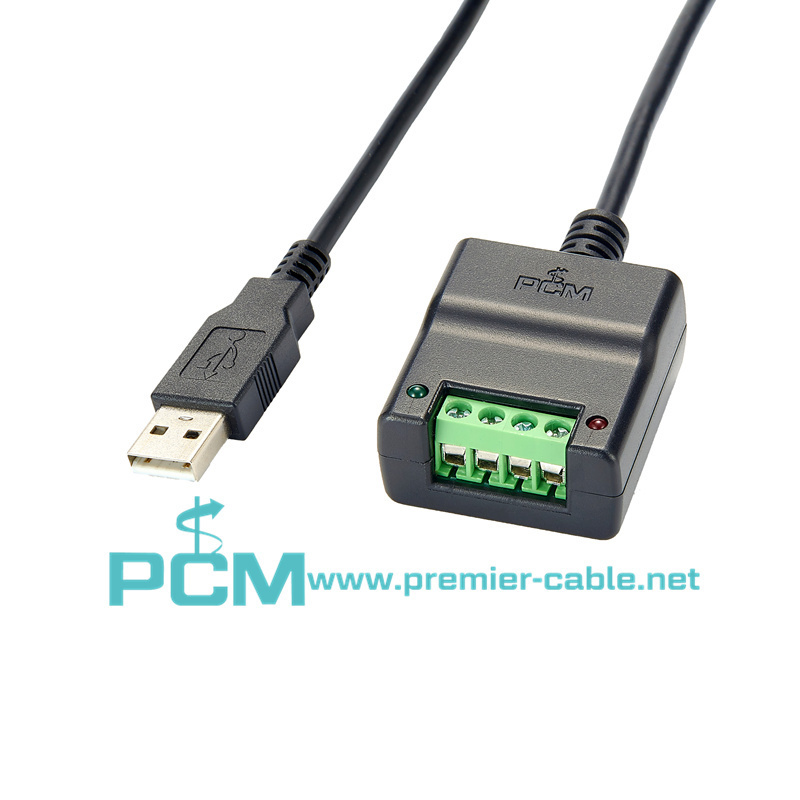
Some key differences between RS232 and RS485:
Number of wires: The RS232 cable consists of 9 wires (DB9) or 25 wires (DB25). Each wire has a specific purpose in data transmission. RS485 has only three wires, one for ground and two for data transmission.
Number of devices: Two devices can be connected using RS232. Through RS485, one master can connect more than 32 slaves. Up to 128 RS485 slaves can be controlled via up to 3 repeaters.
Transmission direction: RS232 is full-duplex and can transmit data in both directions, that is, receive and send. RS485 is half-duplex and can only transmit in one direction at a time. Therefore a host computer is required to control the data flow on the RS485 network. For full-duplex communication, another pair is required (see RS422).
Range: For RS232, the maximum distance between master and slave is 15 m (50 ft). For RS485, the range is up to 4,000 feet (1,200 meters).
Transmission speed: For low data transmission speeds over short distances, the RS232 serial interface is sufficient. It can transmit up to 50 feet (15 m) at 1 Mbps. The RS485 interface can transmit data at a data rate of 10 Mbps. RS485 can transmit at 100 kbps over a maximum distance of 4,000 feet (1,200 meters).
Voltage: RS232 uses a voltage between +12V and -12V, while the recommended voltage for RS485 is +5V and -5V.
Single-ended versus differential signaling: RS232 uses single-ended signaling—one wire for each signal and one wire for ground. RS485 uses differential or balanced signals: two wires for each signal, one with signal (D+=+5V) and one with inverted signal (D-=-5V). We assume the same noise on both lines (eg Vn=xV). The receiver subtracts the two signals D+ minus D- => +5V - (-5V) + xV - xV => +10V. Noise is virtually eliminated.
If you're looking for low data transfer speeds over short distances, RS232 will suffice, although it's a bit old. RS232 is cheaper and easier to integrate than RS485. However, if you need higher data transfer speeds and longer distances, RS485 is better. RS485 is also a better choice if you need to control multiple devices.
Related News
10M Quad MATE-AX & HFM Mini FAKRA 4-in-1 Cable Assemblies Now Available – Stock Ready, No MOQ
The 10M Quad MATE-AX & HFM Mini FAKRA 4-in-1 Cable Assemblies is ideal for connecting cameras, sensors, radar modules, area controllers, and domain control units in modern vehicles, buses, coaches, passenger buses, trucks, and commercial transportation systems.
7/8" Power Cable Solution for AGV and AMR Robotics Applications
Premier Cable’s DeviceNet 7/8" power cables for AGV and AMR robots, deliver the stability, durability, and flexibility required for next-generation robotic systems. Start Your Custom Cable Project Today! Get reliable power solutions for your AGV or AMR system!
GMSL Camera Cables Solution for Automotive In-Vehicle Developer System and Robotic
Looking for reliable and customizable GMSL camera cables? Premier Cable provide GMSL, GMSL2, and GMSL3 camera cable with Fakra and Quad Fakra, customizable for NVIDIA DRIVE AGX Thor Developer Kit, automotive, unmanned vehicles, robotics, AMR, and smart cities.
Premier Cable MATE-AX & H-MTD GMSL Ethernet Cable for NVIDIA DRIVE AGX Thor Developer Kit
Premier Cable provide custom MATE-AX & H-MTD breakout cables for NVIDIA DRIVE AGX Thor, supporting humanoid robots, machine vision, Industrial Vehicles, Robotics, and Autonomous Machines.
How H-MTD Cable Empower Robotaxi and Autonomous Driving Systems
H-MTD cable assemblies enable high-speed automotive Ethernet for Robotaxi, supporting cameras, LiDAR, and ADAS with customizable solutions.
Premier Cable Launches TE 282762-1 2 Way Automotive Cable Assembly
Premier Cable introduces the TE 282762-1 AMP Junior Power Timer automotive wiring harness, customizable, and widely used in sensors, fuel injection, ignition systems, and turn signals.