 Esperanto
 Shqiptare
 Euskara
 Zulu
Zulu
 Latinus
 Cymraeg
 தமிழ்
தமிழ்
 Slovak
 Slovak
 Afrikaans

Products
Product Center
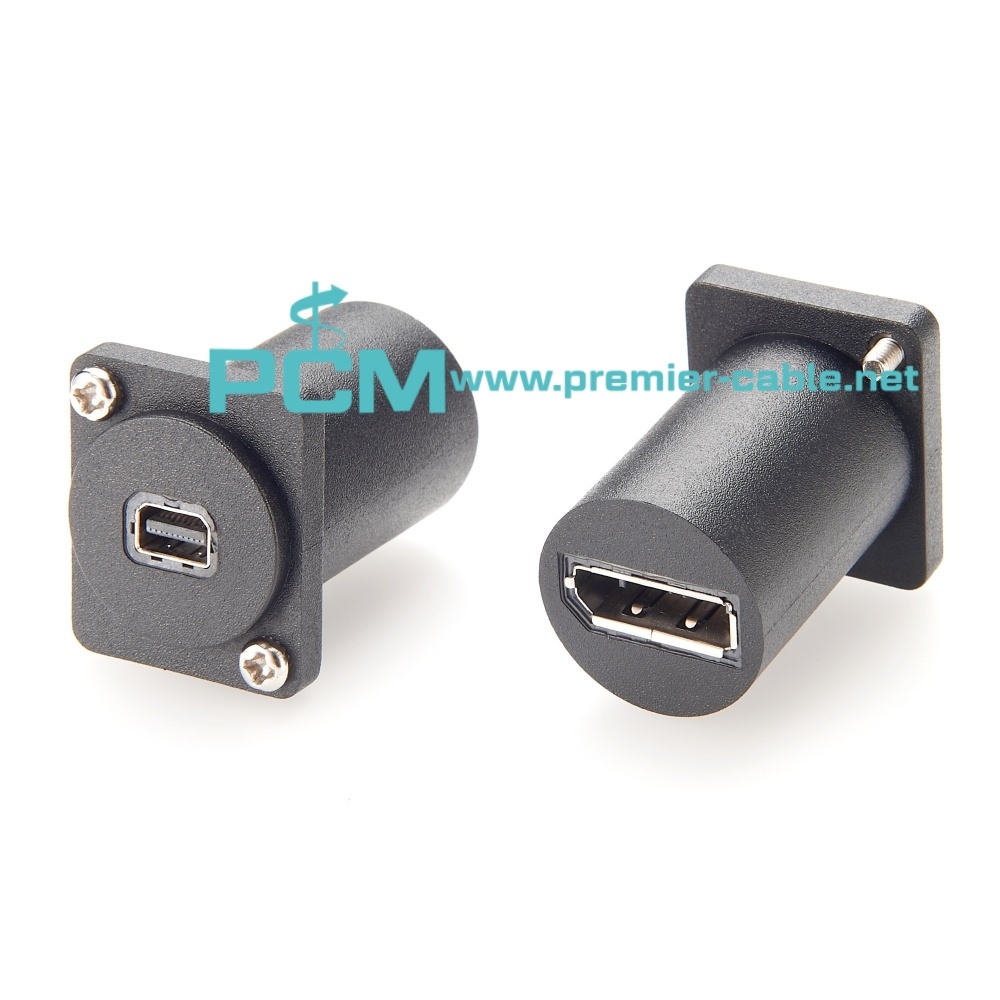


D-type Mini DisplayPort to DP Panel Mount Adapter, MDP to DP
Part Number:
PCM-KW-455
Category:
D Type Panel Mount
Products Description
| Product Name | D-Type MDP to DP Panel Mount Adapter |
| DWG No. | PCM-KW-455 |
| Connector A | Mini Displayport Female |
| Connector B | Displayport Female |
| Resolution | 4K*2K 60Hz |
| Shape | D-Type, Feed-through |
| Design | With Chipset |
| Nut | #4*8PM |
| Custom Service | Yes, OEM/ODM service is available. Please kindly contact us for details. |
What is the difference between DisplayPort and Mini DisplayPort?
Although both DisplayPort and Mini DisplayPort belong to the same category of video and audio interface standards, there are some key differences between them:
1. Physical size
DisplayPort: The standard DisplayPort interface is larger in size and is usually used in desktop computers, monitors, graphics cards and other devices. This interface is relatively wide and has a locking mechanism, which is more stable after insertion.
Mini DisplayPort: The Mini DisplayPort interface is smaller in size and is mainly used in thin and light devices, such as Apple's MacBook, Microsoft's Surface and other laptops. Its design is more compact and suitable for small devices.
2. Uses
DisplayPort: Usually appears on desktop computers, monitors and professional graphics cards, suitable for high-resolution, multi-monitor configuration requirements.
Mini DisplayPort: Due to its compact design, it is common in laptops, ultra-thin devices and small display devices. Apple used this interface extensively until it was gradually replaced by the Thunderbolt interface.
3. Functionality
DisplayPort and Mini DisplayPort are almost identical in functionality. They both support high resolution, multi-channel audio, daisy chain, and high-bandwidth data transmission. Both can support 4K, 8K, and even higher resolutions (depending on the specific version, such as DisplayPort 1.2, 1.4, 2.0, etc.).
4. Compatibility
DisplayPort and Mini DisplayPort interfaces are essentially the same protocol standard, so through the appropriate adapter or adapter, they are compatible with each other. Users can convert Mini DisplayPort to standard DisplayPort, and vice versa.
5. Locking mechanism
DisplayPort has a physical locking mechanism, which is more stable after connection, and requires pressing the buckle to unplug.
Mini DisplayPort usually does not have this locking mechanism, which is relatively more convenient to plug and unplug, but it may not be as secure as DisplayPort in connection.
DisplayPort and Mini DisplayPort mainly differ in physical size, but in terms of function and performance, the two are basically the same. Through appropriate conversion equipment, the two can achieve interoperability.
Leave a Message
Make you smile , is our mission. We are glad to reply all your questions about cables processing or our products. Please fill in the table below. Thank you